
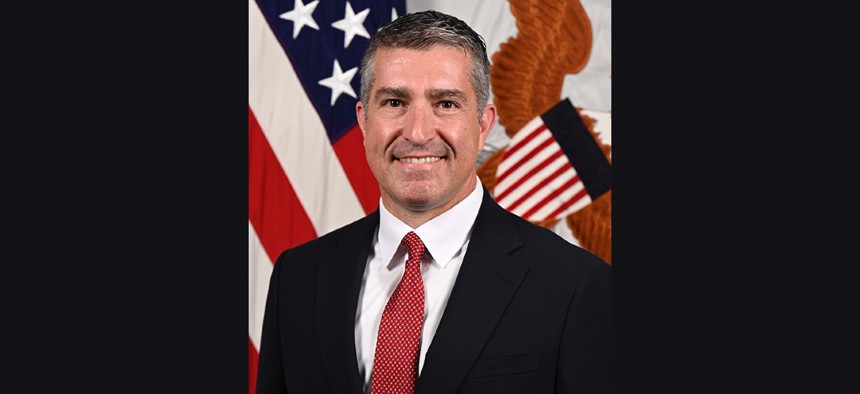
Michael Cadenazzi is the assistant secretary of defense for industrial policy. Defense Department
DOD’s move to ‘wartime footing’ demands new contracting models
The Pentagon's leader for industrial policy says the acquisition regulation overhaul will create openings for artificial intelligence-enabled service models and drive a move away from traditional contracts.

Prime contractors need to move beyond time-and-materials contracts and embrace outcome-based models that lean on artificial intelligence and commercial practices, according to the Pentagon's top industrial policy official.
Speaking Monday at the Professional Services Council’s annual Vision conference, Michael Cadenazzi said the Defense Department is pushing for those kinds of changes through the overhaul of the Federal Acquisition Regulation and its defense-focused counterpart called DFARS.
“This truly is a time for change,” said Cadenazzi, assistant secretary of defense for industrial policy.
He sees industry as having an important role to play by sharing insights and experiences from the commercial world.
“You can help us broaden our perspective,” he said at the conference in Arlington, Virginia.
The buy-in for this shift comes from the top of DOD, where Defense Secretary Pete Hegseth laid out how defense acquisition needs to change during a Nov. 7 speech known as the Arsenal of Freedom.
Hegseth said that DOD needs to put the acquisition on more of a wartime footing. The speech signaled DOD’s willingness to increase its acquisition risk if it means getting needed technologies into the field faster.
“This shift to a wartime footing empowers our people to take calculated risks and rapidly deliver overwhelming capabilities for our war fighters,” Cadenazzi said.
By accepting more risk in how it buys, DOD sees a reduced risk on the battlefield.
“Increasing acquisition risk today to decisively decrease operational risk tomorrow,” he said.
DOD memos describe the need to instill a warrior ethos in the acquisition workforce, as well as “inject a sense of urgency and relentless focus on speed.”
“The department's acquisition transformation is built on five interlocking pillars that move the enterprise from a prime contractor dominated system to a commercially oriented dynamic vendor space,” Cadenazzi said.
One of those five pillars is rebuilding the defense industrial base. The Trump administration is investing directly in companies mining and processing critical minerals, such as nickel.
The reconciliation bill, known as the Big Beautiful Bill, included $10 billion to invest in the supply chain.
“These investments will play an essential role in building a supply chain that is adaptable, resilient and ready to meet any challenge,” he said. “All of this is good news, but we still have a lot of work to do.”
Industry will play a critical role in this push by DOD.
“For years we’ve treated services mainly as labor hours, time and material,” he said. “Now in this technology drive era, how can we pioneer new pathways and redefine what services look like.”
Industry needs to show how artificial intelligence and machine learning can deliver value and at an appropriate price. What are the right pricing models, Cadenazzi asked rhetorically.
“I want your help to create these new pathways and redefine what services look like,” he said.
The Federal Acquisition Regulation overhaul will offer opportunities for industry and the Defense Department to work together. The reforms can also open the door for innovative ways to buy, according to Cadenazzi.
“Show us what models you've seen work in the commercial market and what ideas you think are ripe to try and assess. You'll find a great partner in our office,” Cadenazzi said. “We have a chance to test new business models that create more wins for both government and industry, if we lean into this and work together.”
NEXT STORY: The awful arithmetic of our wars