
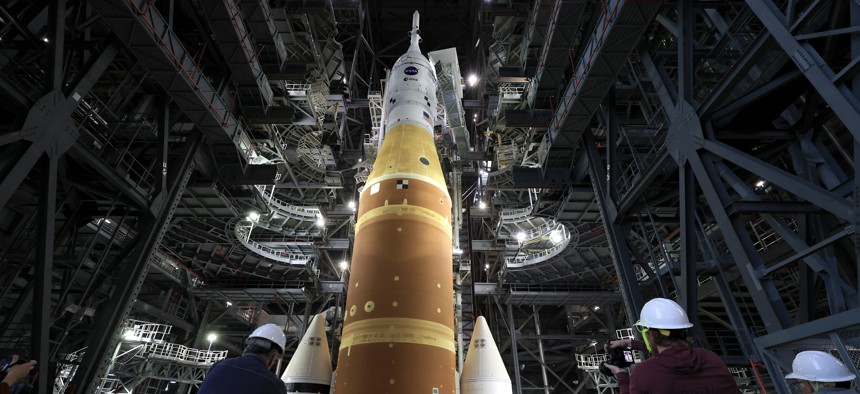
CAPE CANAVERAL, FLORIDA - JANUARY 16: NASA's Artemis II sits in the Vehicle Assembly Building at NASA’s Kennedy Space Center on January 16, 2026 in Cape Canaveral, Florida. NASA’s integrated SLS (Space Launch System) rocket and Orion spacecraft for the Artemis II mission are prepared for a scheduled rollout to Launch Pad 39B before the February 2026 10-day mission, which will take the crew around the Moon and back to Earth. (Photo by Joe Raedle/Getty Images)
Space: the Final Frontier for data processing?
Earth may not be the hub for space-based communications much longer, and for good reason.
As the final countdown commences for NASA’s Artemis II mission to the moon, the question is not whether the space agency has the fortitude to make this and future initiatives possible. The question is whether astronauts and possible lunar habitats will have access to stable, resilient platforms that can process information and make intelligent decisions in real time.
For decades, Earth has been the hub for analysis and decision-making, with terrestrial data centers transforming raw information from orbit into actionable insight. But as NASA quite literally takes its moonshot, this Earth-centered model may prove limiting. High latency, narrow communication windows, and constrained bandwidth can make it impractical, and often impossible, to rely on land-based data centers for timely decisions.
Future missions will require a shift. Resilience and performance will depend on processing information at the edge of space, where astronauts and autonomous systems operate, rather than relying on a data center thousands of miles away.
New technologies make this possible. Advances in modern edge architectures, lightweight containerized workloads, and scalable off-planet compute are redefining what missions can accomplish independently. Just as important, these same technologies will enable future spacecraft and lunar stations to offload more intensive tasks to orbital data centers, creating a layered computing ecosystem designed for sustained exploration.
Edge compute brings intelligence to the mission site
Recent advances in compact AI-enabled hardware now enable spacecraft, habitats, and orbital platforms to perform tasks once handled exclusively by terrestrial data centers. These systems can interpret sensor readings at the moment they are generated, run analytical models on location, and support autonomous or semi-autonomous operations during communication gaps.
This capability fundamentally changes mission operations. Instead of relying on Earth for every assessment, spacecraft and crews can respond immediately to emerging conditions. Edge-based AI agents can guide astronauts through complex procedures when links degrade, and onboard models can adjust as conditions evolve. By enabling real-time decision making, edge computing becomes essential for missions operating far beyond low Earth orbit.
Offloading work from ground-based data centers
Edge processing also reduces the burden on terrestrial data centers. Rather than transmitting large volumes of raw data back to Earth, spacecraft can perform initial analysis onboard and send only mission-relevant insights. This reduces bandwidth demands, accelerates response times, and allows Earth-based infrastructure to focus on tasks that genuinely require scale, such as long-range modeling and deep scientific analysis.
As edge devices assume greater processing responsibilities, orbital data centers provide a scalable middle tier that further reduces reliance on Earth-based servers. These solar-powered platforms can aggregate data from distributed mission elements, run heavier computational workloads, and support coordination across spacecraft and lunar infrastructure. By handling tasks that exceed the capability of smaller edge devices yet do not require the full scale of terrestrial facilities, they extend computing capacity deeper into space.
The result is a more efficient distribution of workloads. Earth handles tasks that require massive compute resources, while smaller workloads and instant analysis is handled in space. By offloading routine and time-sensitive tasks, missions become more agile and less dependent on continuous connectivity.
Keeping systems updated, stable, and adaptable
For edge systems to reliably stand in for Earth-based computing, they must remain adaptable, stable, and resilient, with the ability to handle the same workloads as conventional systems. Missions evolve, environmental conditions change, and software must keep pace. That requires platforms capable of receiving over-the-air updates without physical access and without jeopardizing mission continuity.
Modern architectures enable this through update mechanisms that can recover automatically from failures. If an update encounters a problem, the system must be able to restore itself to a safe state.
At the same time, containerized applications allow workloads to perform consistently across environments, whether on Earth, in orbit, or on the lunar surface. Containers are reproducible open source technologies that bundle together everything an application needs to run in a highly-portable package. This portability simplifies operations and makes it easier to deploy workloads, applications, or models anywhere, including space.
Using technology built on open standards also reduces complexity. Instead of relying on bespoke software stacks that require niche expertise, mission teams can leverage technologies already familiar to modern IT organizations. This lowers the learning curve for engineers, improves interoperability across mission components, and allows space systems to evolve alongside the broader open source ecosystem.
Moving to the edge of space
Powering the next era of space operations requires a deliberate shift to computing capabilities that can replicate traditional processing without the challenges associated with transmitting information back to Earth. Deploying AI-capable edge systems, offloading analysis from terrestrial data centers, and supplementing them with orbital platforms creates an architecture built for continuous exploration.
When systems can analyze, adapt, and respond at the edge, missions become more independent and capable. These systems will be essential to the success of Artemis, commercial space stations, and other exploratory endeavors.