
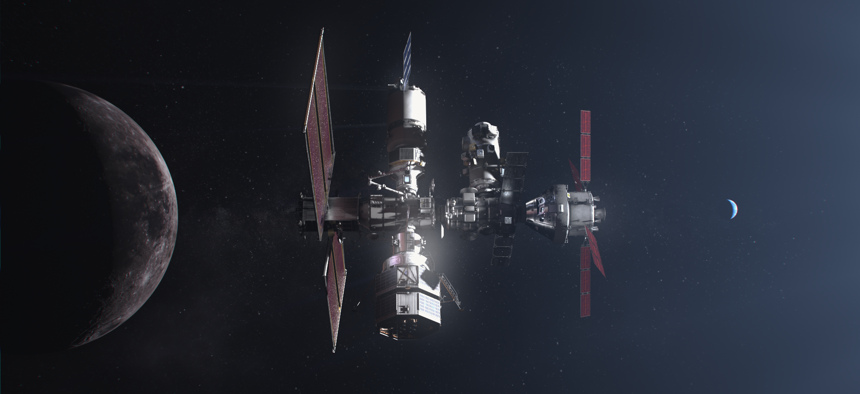
A rendering of the Lunar Gateway illustrates the modular design of the proposed station in lunar orbit. NASA leadership is currently proposing a strategic shift to move this technology from an orbital waypoint to a support role for the moon’s surface. NASA
NASA Scraps Lunar Gateway . . . for Now
NASA looks to repurpose modular orbital hardware for future lunar surface operations

After years of scrutiny from the space community, NASA has officially adjusted its trajectory for the Lunar Gateway. The agency stated it will "pause Gateway in its current form," opting instead to focus on infrastructure that supports sustained surface operations. This move indicates a preference for a moon base over an orbital outpost.
But what exactly is the Gateway? Conceived as a cornerstone of the Artemis program, the Lunar Gateway is a modular space station designed to occupy a highly elliptical orbit around the Moon. Much like the International Space Station (ISS), it is composed of interconnected modules—four are currently planned, with more expected as the program evolves. Its primary mission is to serve as a multi-purpose hub: facilitating lunar landings, conducting deep-space scientific research, and acting as a staging ground for future missions to Mars.
Initial Core Modules
Power and Propulsion Element (PPE) Module: This is the station's powerhouse. It utilizes a 60-kW solar electric propulsion system to provide high-efficiency power, high-rate communications, and the maneuvering capabilities necessary to maintain the station's unique orbit.
Habitation and Logistics Outpost (HALO): Serving as the command and living quarters of the station, HALO provides the core command-and-control systems. It manages energy storage, power distribution, thermal regulation, data-handling, and life support, while also acting as the primary docking hub for visiting spacecraft, such as the Orion spacecraft.
Planned Modules
European System Providing Refueling, Infrastructure and Telecommunications (ESPRIT) Module: Attached directly to HALO, this module provides enhanced communications and serves as the station's central reservoir, storing additional xenon and hydrazine for the PPE’s propulsion systems.
International Habitation Module: Contributed by international partners, the I-Hab module expands the station’s pressurized living space, allowing for longer crew stays and increased scientific capacity.
Specialized Systems
Canadarm3: While not a module itself, this next-generation robotic arm is essential to the station's longevity. Much like the Canadarm2 on the ISS, it will autonomously perform maintenance, move modules, and facilitate scientific experiments on the Gateway’s exterior.
With Gateway modules already in production, NASA now intends to repurpose equipment to support the future Moon base. What this means for the kit already built remains to be seen. While the future of the completed components remains to be seen, the Power and Propulsion Element may find a new life as a nuclear-electric propulsion demonstrator. Regardless of NASA's current intent, the decision to officially pause the program rests with Congress, whose approval is required to finalize the shift.